11
Jan
10

never ending multi-story

Invited to contribute to this exhibition held at the airspace gallery in Stoke-on-Trent, I built an installation out of light, silver card – as large as could fit into the space.

The thought was based around how buildings can be designed to impress and awe those who see and use them. Banks require impressive, sturdy buildings to express their solidity.  The business plan depends on this faith and the bank falls apart when customers decide their mattresses are better places to store  money. In Albert Speer, Hitler found someone who could build for him a capital of such impressive grandiosity it would completely subdue any potential opposition to the will of his Reich by foreign governments or his population. Governors of Berlin were aghast at the destruction these plans entailed.

Built of totally unsuitable material my structure vainly endeavours to look heavy and  monumental, its flimsy transience emphasised by the open back.

The human desire to extend control into the distant future is inevitably subverted by passing time; ultimately all exercises of power are doomed to failure in the physical world (cf  Ozymandias).

The end.

11
Jan
10

Telephones in Marrakesh

In November, took a trip to Marrakesh to help artist Alice Forward with her gold leaf interventions for the Marrakesh BiennaleArts in Marrakesh (AIM).

Staying at the Rhiad el Fenn (words like ‘achingly’ and ‘cool’ spring immediately to mind) it was slightly like Beauty and the Beast, we of course in the role of Beauty.  All our wants  provided for but we met no other artists and saw no art. Perhaps we just werent cool enough? Fortified by magnificent cinnamon flavoured porridge we just went forth and did what needed to be done.

Alice decided to work in the Cyber Park , the intervention was to gild scars on some of the trees  in the park. They were subtly spectacular and poetic when finished. The gardeners were very friendly and we chatted to them (in awful French) as we worked in their garden.

Three of Alice Forward’s  Gold Leaf interventions in the Cyber Park.

This park is sponsored by Maroc Telecom, it has free wi-fi,  a cyber-parlour of computers and a number of on-line terminals dotted about  the gardens. At the entrance is a small museum of historic Moroccan telephones.

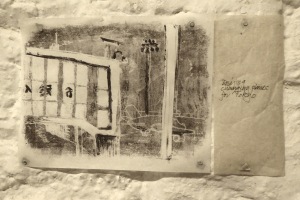
Sketches of some telphones.

My contribuiton was to make a paper model of a telephone and put it in a hollow tree at the other entrance to the park.

26
Nov
09

the streets of Stoke-on-trent are paved with gold

To celebrate the building of what is to be The Largest Tesco in Europe, a huge space in the middle of Stoke-on-Trent’s bustling shopping centre was cleared of now redundant buildings; printing works, potteries and assorted other industrial or business premises of varying loveliness, among which was a very sightly art deco builing called Bullock and Bosson.

In September a Golden Mile of stenciled gold one pound coins appeared around this huge area of demolition. The coins can be seen on the pavement the length of Morley Street, on to Broad Street, then down the sad remains of Robson Street.

Stencil of the One Pound coin.

Businesses in the vicinity claim that the area is like a bombsite and that passing trade is a thing of the past. These merry pounds remind us of the amazing potential for development of commerce and riches this big sky place represents. We should rejoice in the, almost, visible development of our city and our future wealth. The stencils definitely add a celebrational air to the area, perhaps this notable artwork will increase foot traffic in the streets around the site. Stoke-on-Trent City Council were however enraged and sought angrily for the perpetrator of this defacement of their pavements. They deemed it vandalism; unlike the scar resulting from the destruction they had sanctioned which the artwork surrounds.

Broad Street in Hanley, Stoke-on-Trent’s bustling town centre.

Junction of Stratham Street and Morley Street, opposite noted nightspot The Underground.

Apparently the council heavily promoted the site at an industry conference in Cannes in the summer of 2008 (the Sentinel, 29/09/2008), but the advent of Tesco’s largest European store may be some while in the future.  Initially scheduled to open in December 2008, nothing has happened in the area since demolition finished around two years ago.

The wild flowers and plants are looking large, healthy and confident; remnants of human activity less so. The burned out caravan is crumbling gently and will in time provide a haven for small animals and seedling plants. The chunks of broken bricks and concrete are becoming less aggressive in their stance as they become submerged in encroaching greenery. As autumn advances and the rain rains so the coins gradually loose integrity and wash away. The council needn’t have troubled themselves; nature will effect a cure for this disfigurement. This is probably what the end of the human race will look like…

09
Aug
09

The Haywood Charity hospital

Having spent time reading the minutes of the Governors of the Haywood Charity Hospital,  (see July 2008) I have have managed to produce some cyanotypes – blueprints which include with photographs, text from the minutes and words from the conversations of patients of the hospital.

The images are photographs taken in the Day Case Unit printed as cyanotypes, a photographic process which was discovered in the 1840s, it makes lovely soft images and somehow seems to emphasise the fragility of the patients. The text on the images includes both the written minutes from the 1880s and words spoken to me in conversation with patients at the Unit. I have mixed historic, nineteenth century, references with contemporary ones to investigate changes and constants in the way people have cared for each other in the Hospital. through time.

This project was aimed at looking at the past of the hospital in the context of the present; its move into a custom built Private Finance Initiative building.

This move of the Haywood Hospital in 2009 is its third move into custom built premises. The tale of the fist building is to be found in  the Minutes of the meetings of the Governors of the Haywood Charity Hospital which are held in the County Archive at Stafford. The charity had been set up by two brothers who were persuaded by their doctor that a hospital in Burslem would be a good use of their intended bequest. The minutes are written in clear handwriting and though they seem a bit dry at first all sorts of interesting threads emerge as one reads.

The first meeting was in February 1881, a hospital was opened in July 1886. Having determined that the first thing to do is to take on two Town Nurses who could visit patients in their homes.

Three Nurses set up an infusion for a patient, Nov. 2008.

Three Nurses set up an infusion for a patient, Nov. 2008.

Text on image: 28th Sept. 1881
‘Mr Oldham reported that all the Medical Men of Burslem, except Mr Hales, met him on Monday afternoon last and agreed to a suggestion that one of the first objects of the Governors should be the obtaining of services of tow trained Town Nurses, to whom the Medical Men of the town or the public can apply for assistance and nursing. They considered this the most crying want of the town, and one which will be of the greatest public utility. Mr Oldham also handed in particulars of several cases reported to him by the Medical Men as deserving of assistance’

The Governors rented a house Waterloo Road and engaged a housekeeper to look after it. But after this they are continually diverted buy the minutiae of organising everything.

Nurses confer at the Day Case Unit, November 2008

Nurses confer at the Day Case Unit, November 2008

Text on image: 8th Jan 1883.  The Chairman reported his interview with the Housekeeper and Nurses and said he had obtained a promis from that they would endeafvour to live together in greater harmony in the future

Despite reminding themselves frequently about looking for a proper premises only when accused of ‘inchoateness’ (11 June 1883) do they start to get their act together.

Meanwhile the nurses are doing sterling work, two of them, on foot, manage to make 600 – 800 home visits a month.

A wheel chair waits under a poster about the New Haywood Hospital, May 2009

A wheel chair waits under a poster about the New Haywood Hospital, May 2009

Text on image:  11 June 1883 That another Bath Chair be purchased – narrow enough to go through cottage doors.

The minute about purchasing a new ‘Bath Chair narrow enough to fit through cottage doors’ (11 June 1883) is a sad reminder of the poverty of the area at the time. They  had bought a bath chair the previous year, but must have found its width a hindrance.

Awful working conditions, poor nutrition and poverty were the lot of most working people at the time; the nurses could provide first aid, food and respite but not much else, none of the drugs we take for granted were available then. Falling into the clutches of a Victorian doctor was not necessarily good news; Pasteur’s germ theory of disease was only 20 years old at this time.  The minutes contain details of trader’s tenders for the supply of ‘fleshmeat’ which was used for making beef tea and such for patients and there are also minutes about issuing tickets for patients to get meals at the Borough Coffee Shop (12 March 1883). Patients could be sent to convalesce in healthy environments, such as Buxton (11 June 1883) and this is probably the reason for the suggestion that the Charity might like to build in Llandrindod Wells (11 July 1881).

The modern Day Case unit is a good contrast, highlighting how far medicine has come over 125 years or so. But talking to patients highlights how some important aspects of what the Haywood gives has not changed.

Infusion for osteoporosis, May 2009

Infusion for osteoporosis, May 2009

Text on image:  10 Decr. 1884. That the tender of Mir J.W. Knight, to supply fleshmeat to the 25th March at the following prices,  be accepted, –

Gravy Beef  7d lb

Neck of mutton 9d lb

Legs do.  10 1/2d lb

Fleshmeat for the Home 10 1/4d lb   all of the primest quality.

The tradition of nurturing and personal attention is alive and well: ‘This place is a five star hotel!’

They treat you as a person; cant do enough for you…

‘They give you tea and coffee and even lunch – and its so nice!’

The treatments though are at the cutting edge of twenty first century medicine. Where once flannel undergarments (stamped with the charity’s name, 10 April 1882) were loaded out, now patients come in for infusions of biologically active drugs; humanised monoclonal antibodies. James and David, two most cheery people had had intractable rheumatoid arthritis which had resisted most treatments until they were put on a trial for a new monoclonal, now they were suggesting Roche might like to send them to Switzerland to show off how good the results were!

Two patients receive infusions at the Day Case Unit, November 2009

Two patients receive infusions at the Day Case Unit, November 2009

Text on image: 11 June 1883. A letter of thanks read from Mr Cooke who stated that his visit to Buxton had almost made a new man of him. signed by James Maddox, Chairman of the Meeting at which these Minutes were read and confirmed.

10 April 1882. That a suit of flannel underclothing stamped with the name of the Charity be obtained under the direction of the Nurses lent in the first place to —– Boulton, Sneyd St, Cobridge.

Painful hands and Patient feedback machine, May 2009

Painful hands and Patient feedback machine, May 2009

Text on image: Daily Telegraph June 16 2009

Drug hope for arthritis

As many as 250,000 rheumatoid arthritis sufferers could benefit from a drug that can halt the disease in its tracks Almost half the patients with early arthritis symptoms in a trial saw significant improvements in their condition after a year. The drug, MabThera (retuximab) stops the  deterioration of the joints …

The article from the Telegraph is about an anti B-cell monoclonal being used rheumatoid arthritis, probably similar to the one in the trial James and David are on.  I feel that the pessimism of the lady who’s hands I photographed may not be justified, and I hope  this will turn out to be a more optimistic story in the end.

07
Aug
09

the machine itself: nowhere/somewhere/everywhere 3

At last a video of the machine itself.

The machine was set up in a dark space with lights in the drawer of one of the filing cabinets so that shadows of the models were cast up onto the wall behind. There are lots of words about the piece in the previous post.

he machine had an outing  to Free Range at the Truman Brewery in Brick Lane in July  and will have a further outingto the Wirksworth Festival 12 – 25 September. A photo is to be found therein also.

08
Jun
09

nowhere/somewhere/everywhere 2

Playing in the dark with the models produced quite poetic moving shadows and I felt compelled to make a video.

The sounds reflect my thoughts on an uninhabited arctic wasteland, where installations are left from one year’s end to the next. Like the nuclear-powered lighthouses built around the northern coasts of the erstwhile USSR now looted for their copper wiring, the looters will have got hotter swag than they may have hoped for. 

For the degree show, the models were attached to a conveyor belt mounted on filing cabinets so that they circle relentlessly. There is a light shining on them so that moving shadows are cast on the wall behind the machine.

Models attached to the conveyor

Models attached to the conveyor

Detail of models on machine

Detail of models on machine

The machine.

The machine.

The filing cabinets were a particularly lucky find and added considerations of bureaucracy.

The piece is displayed in dark space and can be viewed only through a narrow slit, like a gun-sight in a thick concrete bunker. This is significantly frustrating; clearly for the convenience of those within not those without.  It is suggestive of paranoia and concealment as well as  of value; something here was considered to be in need  of preservation through extreme circumstances.

The conveyor circles between the cabinets. In the drawers are forgotten, official looking documents. Everything is grey. Overall the work has an air of ‘retro-futurism’ the circling of the conveyor reminds of bureaucracy; regulations and restrictions are engendered because they become possible to enforce not because they are ‘needed’. Statutes remain though the reasons for their existence are lost, their original purposes subverted.

Like a Kafka office, empty but for a ringing phone, this office is long forgotten, down some secret corridor. No knows who is meant to work here, yet edicts continue to be ground out; directives circle endlessly. The models though small are not benign, like the creeping restrictions which are enacted unnoticed, and morsel by morsel freedoms are eroded as governments draw secrecy and paranoid around themselves.

The models are enigmatic – military? Industrial? Functional? Derelict? They do not reveal their secrets.

Secrets can be old and decayed but secrets they remain.  Secret graveyards of abandoned nuclear submarines and naval ships of the USSR in arctic seas were far from prying eyes until Google Earth revealed their slender silhouettes. They will remain for a long time, slowly seeping radioactivity and other noxious effluents into the sea. Biological activity in Polar Regions is so slowed by cold that insults to the environment remain as unchanging scars. Vegetation does not grow over exposed soil; the detritus of World War II fighting is still scattered on the surface of battlefields of north Finland and the Kola Peninsula. Poisoned land and sea will stay poisoned. The sounds evoke this arctic coldness and desolation, a whistling wind and clanking metal with an electrical hum, suggesting activity but deserted.

The title, Nowhere/Somewhere/Everywhere, suggests that though based on nowhere  and despite a slightly ridiculous, pathetic air there is much in the world to which it could refer and that which it references – the will to power – is something to be universally guarded against.

06
Jun
09

the Rebirth project- Goodbye Fanny Deakin

Rebirth is a celebration of the move, during the spring of 2009, of the maternity department of University Hospital of North Staffordshire from the old City General Hospital maternity block, opened in 1968, to a new building.  Various local artists and students from Staffordshire University responded to the call for proposals for work to contribute to the celebrations.

Following the transfer, on 31st December 1970 of the work formerly undertaken at the Fanny Deakin Maternity Hospital, Chesterton, and in continuing apperception of the services rendered in the field of maternity care by the late Mrs Fanny Deacon this floor was named the                         FANNY DEAKIN MEMORIAL WARD

Following the transfer, on 31st December 1970 of the work formerly undertaken at the Fanny Deakin Maternity Hospital, Chesterton, and in continuing appreciation of the services rendered in the field of maternity care by the late Mrs Fanny Deacon this floor was named the FANNY DEAKIN MEMORIAL WARD

On a visit to the old Maternity Building I noticed a plaque on the fifth floor, which was no longer a functioning ward but had been entirely given over to administration, labelling it as the ‘Fanny Deakin Memorial Ward’. Investigating Fanny Deakin I found she had been born in 1883 and was an activist and politician from Silverdale. She was the first woman elected to Wolstanton council in 1923 where she lead a successful campaign for improved care and nutrition for mothers and babies in the desperately underprivileged local communities, which resulted in free milk being distributed by councils to pregnant women and children. Only one of  her own five children survived to adulthood. She died in 1968.

In recognition of her work a local maternity hospital, opened in 1947, was named after her. It was closed in 1970 and the work subsumed into the Maternity department of the City General Hospital.  So by stages the memory of Fanny Deakin and her championing of the working people of the area is fading away.

The piece is entirely sound. When the building ceases to be used, the sounds of its functioning will be lost irretrievably: the particular squeak of a particular door, the echo of footsteps in the stairwell, the clunk and tinkle of a specific person’s inimitable way of pushing the tea trolley. These sounds are so prosaic, so un-noticed and ignored, but they are totally specific and unique to the building.. To any one who worked or spent time in the building they would be intensely evocative.

In the sounds is a journey from the entrance lobby with a visiting child chatting to adults and running about, up in the lift to a functioning ward where a new-born is having a nappy change; he urinates suddenly and the nurse hoots with laughter and suggests she now needs a shower!! The phone rings and nurses and ward staff chat. We then move to the stair well and hear footsteps and other noises, from there to a floor above where banging doors and light switches echo in the emptiness. The lift then descends to the ground floor and out into the dusk where birds are cheeping sleepily in the trees and traffic passes, as do we, on our way to the new maternity facility.  (I havent been able to up load the file; I need to save it in some different format, but anyhow it is about 28 minutes long and will get up here eventually)

I am interested in sound, it seems to access old, deep parts of the brain, as does smell, and somewhat bypasses the newer more rational functions.

I wanted to create an evocation of the working of old building which has now been totally lost and is almost impossible to recall or re-create. I would like to think that people who spent large amounts of time in the building would recognise some of the sounds.; the door that shouldn’t be pushed until just the right moment after the buzzer sounds, the particular voice of the lift. It might also be of interest to people who have changed from visiting that building to visiting the new one during their pregnancies.

Sounds in the new building will be completely different , despite the fact that both buildings are designed to fulfil the same function, hearing the sounds of the old building in the new one will create a kind of bridge to accompany the transfer of function from old to new.

In a hospital visitors spend quite a lot of time hanging about waiting for something to happen, in that context I think art needs to be a bit more complex and engaging than – ‘oh that’s pretty’.

22
Apr
09

Nowhere/Somewhere/Everywhere 1

From the shadow photos it was clear that either they or the models must move, moving the models seemed easier so I embarked upon making my machine.

Now we are on the home strech to the degree show and if one has time to think the only rational response is deep-down-where-it-really-counts panic and stress.

Having shown the tank rubbing the question was – where next? As usual I was bereft, idealess.  So, perhaps,  make a textile tank, full sized? In which case, one place to start is by making models of the sorts of structure which might support the floppy tank. They could all match or all be different; such things as church towers, houses, classcal columns, pylon-like structures…

Naturally the models got a life of their own and seemed likely to cast interesting shadows.

Shadow of a Tank

Shadow of a Tank

But then it seemed the tank had been overtaken; the models could stand alone.

Their first outing was spread on the floor. Separate, dispersed, gray models on a gray floor.

Models on the floor 1

Models on the floor 1

Models on the floor 2

Models on the floor 2

The mouse’s eye view of the models was quite compelling, and not visible to human viewers who merely had to try not to step on the art.

Stenciled prints based on the photos translated the tiny into large.

Spray paint 'print'

Spray paint stencil 'print'

Spray paint 'print'

Spray paint stencil 'print'

After the shadowphotographing it was obvious that either they or the models had to move. Moving the models seemed easier, thus I ermbarked upon making my machine.

21
Feb
09

Requiem for a Tank

Having been told there were a lot of military vehicles in a local scrap yard, I went to have a look. There are massed lorries, fire engines some refuelling tankers and a Chieftain tank.

Massed Bedford Lorries

Massed Bedford Lorries

A pair of Green Godesses

A pair of Green Godesses

Cab view of Godess

Cab view of Godess

The tank is draped in rotting tarpaulins which are all tied up with washing line and weighted down so not movable. The turret is turned facing backwards with the gun resting on a bracket at the back of the hull, this is it’s transport mode.I think it may be an early model as the first ones had a split entry hatch as this one has. The gaffer of the yard says it was the last one they bought and he decided not to break it up, it has been there about ten years and he thinks it may have seen action but would need to look inside for the serial number to find out where.

The Tank

The Tank

Draped tarpaulins

Draped tarpaulins

Looking down on the cupola

Looking down on the cupola

Eye to eye

Eye to eye

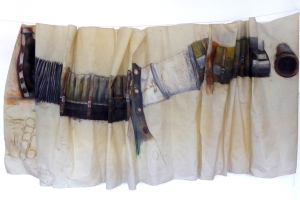
So – what is one to do with a tank? I decided that rubbings of it might be interesting. Clearly a functional tank could not be treated like this, only a decommissioned one could be subjected to this indignity.  So the rubbings are traces of a thing already past. This is an investigation of the iconic visual status of the tank versus its current condition; outdated, immobile, dead. This stranded behemoth has a small, shiny padlock closing its entry hatch. Rubbings of the full length of its 5m gun and some of the many hatches and covers have been done onto calico, which emphasises stitching and woven texture in the canvas lagging on the gun.

The rubbings onto textile have something of the shroud about them; fabric marked with visible traces of what it once covered.They  have translated these tank parts into shadowy, insubstantial and rather vulnerable, feminine things; it is not clear what they might be. The image is of a stilled weapon, but the fabric moves in response to passing people and opening doors. All a contrast to the quite substantial military looking brackets from which the fabric is suspended.

A 5m gun on calico

A 5m gun on calico

Installation view

Installation view

In work such as Nuclear Sail, or the Aircraft-carrier Bird Bath, Ian Hamilton Findlay explores the paradoxes of military machinery; visually gripping hardware but with a function which is so remote to those of us who have never experienced conflict that is easy to discount or ignore.

Ian Hamilton Finlay 'Nuclear Sail', polished slate.

Stella Brennan in her slow moving, contemplative video South Pacific (2007) gives another perspective on the aftermath of war in looking at how WWII influenced culture, communication and perceptions of that remote part of the world.

Stella Brennan South Pacific 2007

Stella Brennan South Pacific 2007

18
Feb
09

the beauties of Stoke-on-Trent: electircity sub-stations-

Aquinas Street

Aquinas Street

The fist electricity sub-station I noticed is in Etruria. A massive brick building that seems to be based on the early dynastic Egyptian mastaba tomb. Once you become aware, subs-substations start appearing all over the place. Their unifying charicter is the yellow notice on the front door showing the chap fatally struck by lighening, also on the front door is their name, usually that of the street in which they are situated.

In the way that banks, who’s business is based on trust, have buildings designed to inspire confidence through a look of solidity, of permanence, of dependability, Electricity Sub-stations seem to display a similar sort of self-satisfaction.

These buildings of a prior age have been built to a high specification, they include un-needed flights of decorative fancy, they seem to be ‘built to last’, to express a confidence in the future, there is an optimism and a quaint ‘futuristicness’ about them and, like so many other interesting buildings, they will pass, probably un-mourned. A fine rather Art Deco-Egyptian substation has disappeared since I photographed it. The replacement has no  aesthetic attributes, it is just housing for necessary equipment; an optimum between cost and protection.

I have been making stencils of the substations and with collaged colour; they have a certain look of 1930s tube posters. The interest in stencils started from a wish to convey monotony through repeated images in the second year.  I very much like stencilled images; the contrasting sharpness of cut lines and the softness of sprayed paint. Where spray escapes the stencil’s restrictions it seems almost to suggest the aura of power emanating from these silent buildings.

Belgrave Road

Belgrave Road

Eagle Street

Eagle Street

Keelings Road

Keelings Road

Belmont Road

Belmont Road

Kingsway, a sub station in the centre of Stoke, having acquired festive decorations, became a Christmas card. There is an interesting air of  misty night around the lamp and the Christmas lights.

Festive Sub-station

Festive Cards

Festive Cards